
Find Your Nearest TRIM Specialist

Our Services and Solutions

Loose floor tiles
What is a loose floor tile?
You feel this one before you hear it. The tile rocks slightly underfoot, or a group of tiles creaks and shifts as you cross the room. Grout lines crack and crumble, and in bad cases the tile lifts enough to catch a toe. It has lost its adhesive contact and is being held in place by the grout around it.
How do floor tiles come loose in Sydney?
Terrace housing is the classic case. Narrow, deep, often over a century old, and frequently renovated multiple times, these homes have timber floors that move and substrates that have been built over rather than replaced. Tiles fixed to that kind of accumulated history rarely stay put indefinitely.
Apartment stock produces a different version. High-density living means heavy use across a small floor area, and buildings that flex slightly, particularly in the upper levels of tall buildings, put stress on rigid tiled surfaces that a detached house on the ground never experiences. Coastal properties add salt exposure to the mix, which works into grout and degrades the adhesive bed beneath it.
Should I replace loose floor tiles or repair them?
What decides it for most people is whether the tiles are still available. Replacement is rarely partial, because a tile from the same range years later will almost never match, so a handful of loose tiles becomes the whole floor. Tile repair treats them individually and keeps the floor you have, at a fraction of the cost and in a day rather than a week.
How does TRIM repair loose floor tiles?
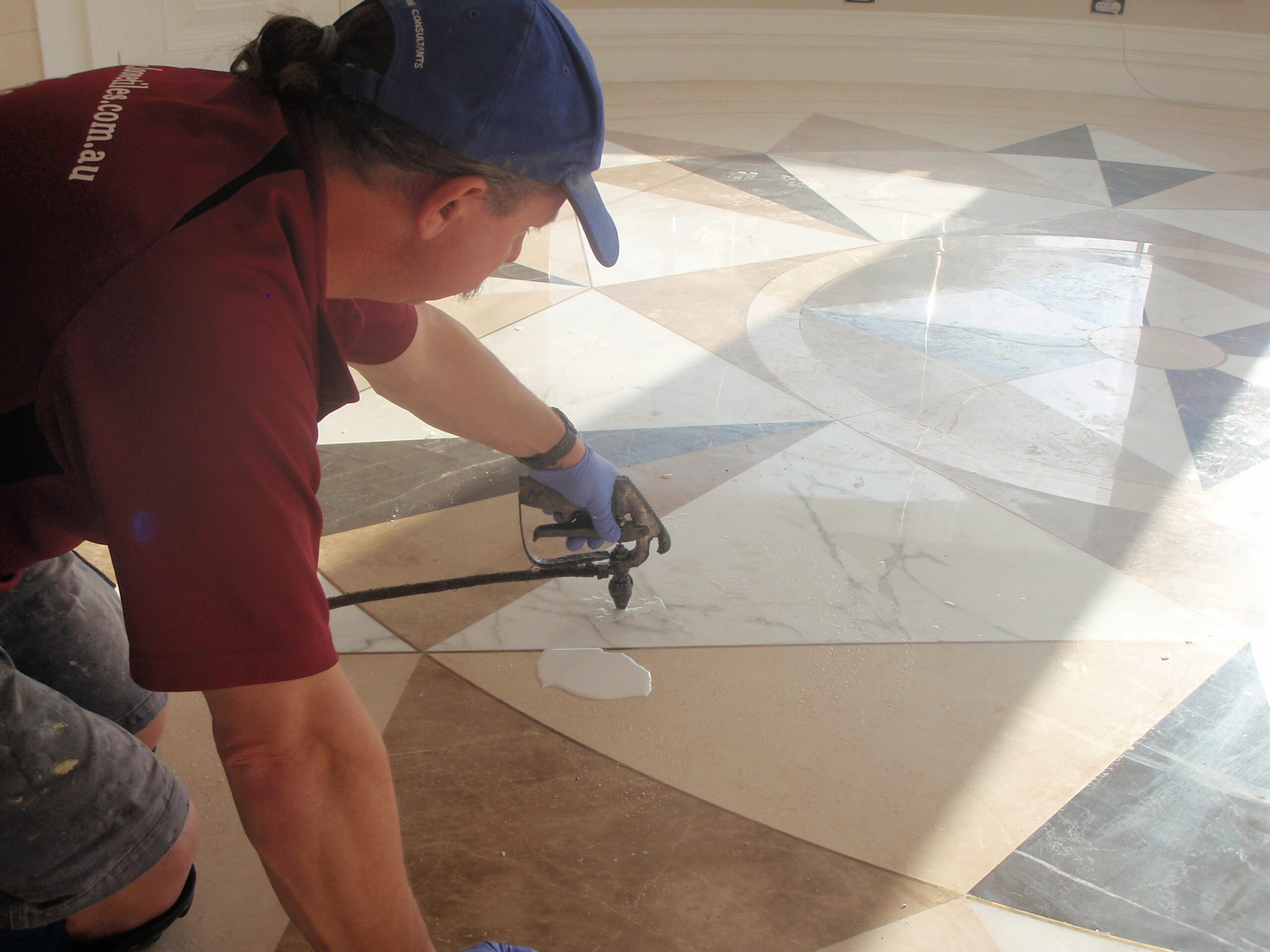
The method is built around not moving you out. Injectabond adhesive goes into the void beneath each affected tile through small access points, re-bonding it in place with no removal, no dust and no skip bin in the driveway. Furniture goes back the same day, backed by a 10 year workmanship guarantee, a 10 year adhesive and product warranty, and a method with a 25 year tested service life behind it.

Peaked and tented tiles
What are peaked or tented tiles?
This is the failure that announces itself. Tiles lift away from the floor and meet in a ridge, sometimes overnight, occasionally with a crack loud enough to wake the house. The tiles have not shrunk or broken. The floor has run out of room, and the pressure has nowhere left to go but up.
Why do tiles peak and tent in Sydney?
Balconies and courtyards are where most of it happens. Sydney summers put sustained heat into unshaded tiled surfaces, and a suspended balcony slab has no way to release expansion at its edges because the building holds it in place. The tiles take the load instead.
Building-scale movement is a factor unique to dense areas. Structures settle and shift, adjacent buildings and excavation work transmit movement through the ground, and a tiled floor that was laid tight against a wall with no perimeter joint has no tolerance for any of it. Large format tiles, which dominate apartment fitouts, concentrate the same expansion into fewer joints and raise the pressure at each one.
Should peaked tiles be replaced or repaired?
Tile repair is the better answer, provided the pressure is dealt with and not just the tiles. Replacement is the expensive route to the same place: full demolition, the whole floor out because a partial job will never match, and no guarantee against it happening again. TRIM treats the cause rather than the symptom, without pulling your floor up.
How does TRIM repair peaked and tented tiles?
The pressure comes out first. TRIM relieves the built-up compressive force in the floor, then re-bonds the affected tiles with Injectabond adhesive injected into the void beneath them, restoring a level, secure surface. Where the original floor lacked adequate movement provision, that is addressed as part of the repair. Floors and walls alike, no demolition, and a 10 year workmanship guarantee alongside a 10 year adhesive and product warranty.

Drummy tiles
What is a drummy tile?
Tap one with a coin and you will hear it straight away. A properly bonded tile returns a solid, dull note. A drummy tile sounds hollow, because the adhesive beneath it has released and left an air pocket. The tile itself is usually undamaged. It simply is not attached to anything anymore.
How do drummy tiles occur in Sydney?
Sydney is geologically split, and which side of the line a property sits on matters a great deal. Much of the city is built on Hawkesbury sandstone, which is stable, but large areas of the west and inner west sit on Wianamatta shale, which weathers to a reactive clay that moves with the seasons. Two houses ten kilometres apart can have completely different ground conditions beneath them.
Where shale-derived clays are involved, slab movement follows the usual pattern of seasonal shrink and swell, and the tile adhesive fatigues over successive cycles. Where the ground is stable, drummy tiles more often trace back to how the tiles were laid than to anything underneath them.
Should I replace drummy tiles or repair them?
The problem is the bond and not the tile, which makes drummy tiles the best case there is for repair. Replacement means demolition, dust through the house, days without the room, and the near certainty that your original tiles are discontinued and the new ones will not match. Tile repair addresses the actual fault and keeps the floor you already have.
How does TRIM repair drummy tiles?
TRIM sounds the floor first to map exactly where the voids sit, then injects Injectabond adhesive through discreet access points, restoring up to 90% contact coverage beneath the tile. Nothing is removed and there is no demolition. Your floor takes foot traffic within hours, covered by a 10 year workmanship guarantee and a 10 year adhesive and product warranty.

Loose wall tiles
What is a loose wall tile?
A debonded wall tile sounds hollow when tapped and will often move slightly under hand pressure. In bathrooms the grout usually goes first: hairline cracks appear, then grout starts falling out, then a tile shifts. The real concern is what gets behind it, because water reaching the substrate through a failed tile line will find the waterproofing membrane.
How do wall tiles come loose in Sydney?
Bathroom size is part of it. A lot of Sydney bathrooms, particularly in apartments and terraces, are small, internal and modestly ventilated, and a small room takes on heat and moisture faster and holds it longer than a large one.
Coastal humidity keeps the substrate from drying, and in beachside suburbs salt in the air adds a chemical dimension to what is otherwise a physical problem. Older terraces contribute solid masonry walls that transmit damp from outside, and a wall carrying rising or penetrating moisture will push tiles off it eventually no matter how well they were fixed.
Should loose wall tiles be replaced or repaired?
The gap between the two options is wider on walls than it is on floors. Replacing wall tiles means removing shower screens, taps and vanities, cutting out the old surface, and very often disturbing waterproofing that is currently doing its job. That turns a tile problem into a bathroom renovation. Tile repair leaves all of it in place.
How does TRIM repair loose wall tiles?
Injectabond adhesive is injected through discreet access points into the void behind the affected tiles, drawing them back to the substrate. No fixtures come off the wall, no tiles come out, and there is no dust through the house. Most bathrooms are back in service the next day, under a 10 year workmanship guarantee and a 10 year adhesive and product warranty.

Spot bonded tiles
What does spot bonded mean?
Spot bonding is an installation shortcut. Instead of trowelling adhesive across the full back of the tile, the installer places five dabs and presses the tile onto them, leaving most of it suspended over empty space. The tile ends up with a fraction of the bond strength it should have, which is why Australian Standards call for near-full adhesive coverage.
Why do spot bonded tiles fail in Sydney?
The volume of multi-residential construction means a great many tiled floors, and the ones laid quickly are the ones that fail.
The conditions then do the rest. Balcony slabs cycle daily through heat and cool, buildings move, shale-derived clays shift the ground under low-rise stock, and coastal moisture reaches the cavity behind every partially bonded tile. A properly bedded tile has the coverage to ride all of that out. A spot bonded one is depending on conditions that this city does not provide. Because it is an installation defect rather than wear, the failure pattern tends to be an area at a time, and that is frequently the detail that determines how the matter gets resolved between an owner and a builder.
Should spot bonded tiles be replaced or repaired?
Replacement is what most people get quoted first, and it is the wrong starting point, because the tiles themselves are perfectly good. The installation failed, not the product. Tile repair puts the missing adhesive where it should have gone originally, without demolishing a floor that only needs bonding.
How does TRIM repair spot bonded tiles?
The voids left by the original installation get filled. Injectabond adhesive goes into the empty space behind each tile, building coverage back up to as much as 90% contact with the substrate and giving the tile the bond strength it should have had from day one. Nothing is lifted or removed, and the result is backed by a 10 year workmanship guarantee, a 10 year adhesive and product warranty, and a method with a 25 year tested service life.
Why Choose TRIM on the Gold Coast

Value for Time and Money

National Franchise Opportunities
Australia-Wide Services
100% Customer Satisfaction
FAQ
Get in touch with our team today!
Why remove and replace? Inject and save!
TRIM services are available throughout Australia by fully licensed and insured contractors.