Hollow-sounding tiles in the shower, a slight give behind the splashback, or drummy patches that keep spreading across a bathroom wall are all signs that your wall tiles have come loose from the substrate. Left alone, the problem only gets worse. In a wet area it becomes a water damage issue as well as a cosmetic one. Most owners assume the only fix is to rip the tiles off and start again. That is not the case. With Cavity Bridging Injection, debonded wall tiles can be refixed in place, without removal, and without replacing a single tile.
What is spot bonding, and why does it cause tiles to fail?
Spot bonding is a tile installation method where adhesive is applied in separate dabs on the back of a tile, rather than as a full continuous bed. It leaves voids and cavities behind the finished tile.
This method is only meant to be used with specific adhesives designed for it. Most installers reach for standard cement-based or dispersion adhesives, which are not meant to be spot applied. When that happens, the installation is defective from the day it goes in, even if the tiles look fine on the surface. If you are wondering whether the drumminess you are hearing is actually a problem, our guide to hollow-sounding tiles walks through when it is and when it is not.
In a wet area, hollow cavities behind the tiles can hold water where you cannot see it. Over time that water damages the substrate, breeds mould, and affects the air quality in the room. This is exactly what the Australian tile installation standards and the National Construction Code requirements for wet areas are designed to prevent.
How the Tile Reglue Injection Method works
T.R.I.M stands for Tile Reglue Injection Method. It is a rectification technique developed to refix debonded tiles without disturbing the tile face or surrounding tile work. Our rectification service uses Injectabond, a purpose-made pressure injection adhesive that flows into the cavity behind the tile through small access points drilled through the existing grout joints.
The process follows a consistent sequence:
- Inspection and mapping. Trained operators identify debonded tiles using thermal imaging, resonance testing, and test drilling through the grout joints to check cavity depth.
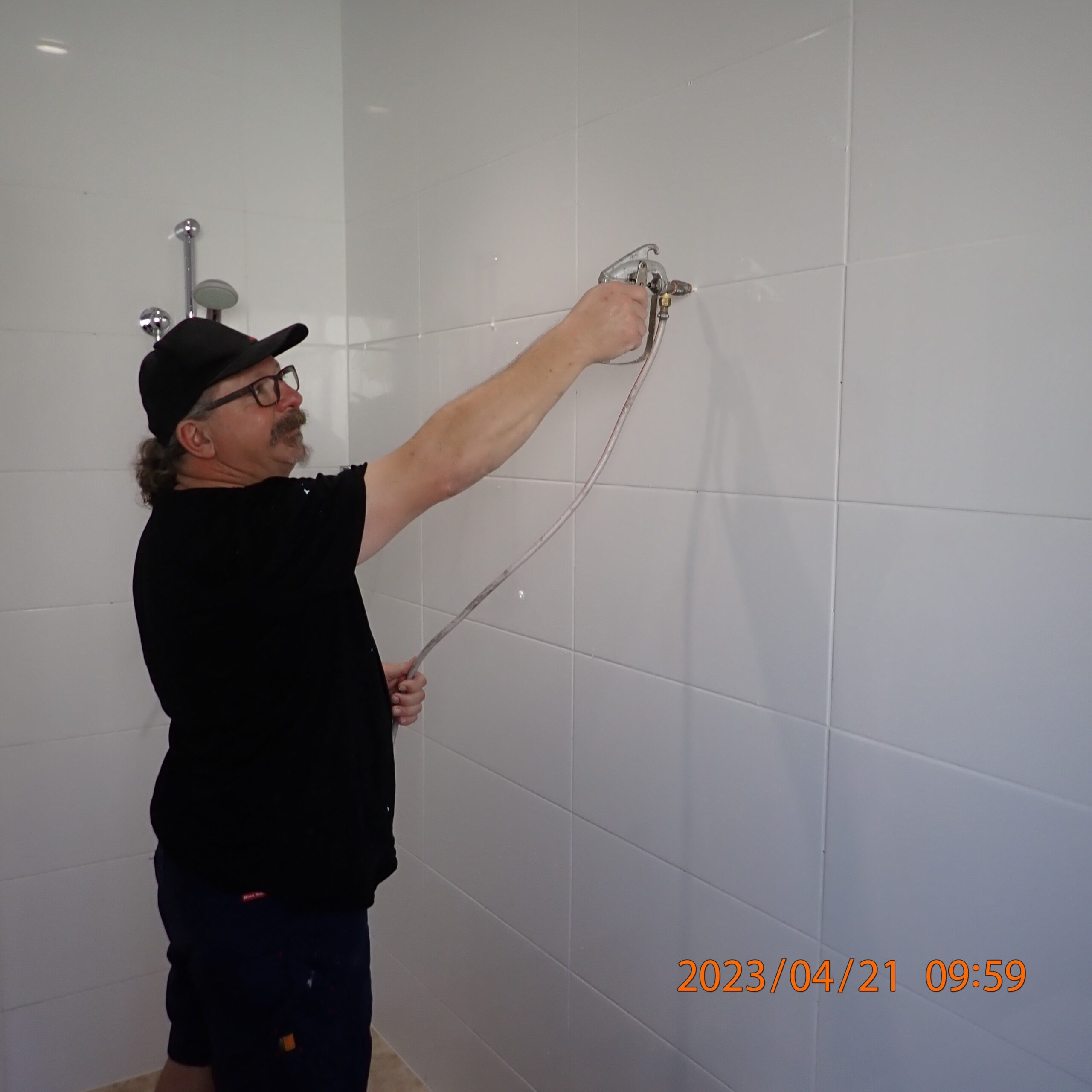
- Injection. Injectabond is pressure injected through the grout joints until the cavity behind the tile is filled.
- Grout refurbishment. The disturbed grout joints are reinstated to match the surrounding tile work.
- Cure and verification. The repaired tile is ready for general use within a short curing window, and post-injection thermal imaging confirms the result.
Because no tiles are removed, there is no need to source spare tiles or worry about mismatched batches. The waterproof membrane behind the tiles is not disturbed. Repairs are completed while the property is occupied, with no dust, no mess, and no fuss. You can see the full process on our How It Works page.
Compliant with Australian standards
Tile debonding in a wet area is more than a cosmetic problem. It is treated as a building defect under Australian Standards and the National Construction Code, and when it is left unaddressed it exposes the substrate to water ingress, voids the adhesive manufacturer’s warranties, and devalues the property.
Cavity Bridging Injection using Injectabond is a recognised way to bring defective tile installations back into compliance. Injectabond is manufacturer-tested and fit for purpose as a pressure injection adhesive, and when it is delivered to the adhesive coverage level the standard requires, the installation is considered compliant again. Thermal imaging before and after the works gives you a documented record of that outcome.
Why in-situ rectification makes sense
Stripping tiles off a wet area wall is disruptive and expensive. You lose the waterproof membrane, you need matching tiles (which often no longer exist), you spend days out of the bathroom, and you carry the dust and demolition through the rest of the home. In-situ rectification avoids all of that.
- No demolition. Tiles stay on the wall, and the membrane stays intact.
- No dust or mess. Work is clean, so the property remains occupied.
- No tile matching. Spare tiles, obsolete ranges, and batch differences stop being a problem.
- Faster turnaround. Most jobs are complete in a fraction of the time a strip and retile takes.
- Lower cost. Repairs are typically a fraction of the cost of full tile replacement.
For commercial buildings, strata-managed apartments, and family homes alike, the difference between a quick in-situ repair and a full bathroom strip-out is significant, both financially and in terms of disruption to daily life. Examples across a range of property types are on our residential and commercial projects page, and you can read feedback from past clients on our testimonials page.
Warranty-backed, with 30 years of proof
Every TRIM rectification is supported by a 10 year workmanship warranty, a 10 year Injectabond product warranty, and a 30 year track record of successful rectification jobs across domestic and commercial properties throughout Australia. All work is carried out by fully licensed and insured contractors.
Book a site inspection
If your wall tiles sound hollow, feel drummy, or you suspect water damage behind them, a site inspection is the best next step. Our team will assess the tiles, document what they find with thermal imaging, and confirm whether Cavity Bridging Injection is the right fix for your situation. We service Brisbane and South-East Queensland, the Gold Coast and Northern Rivers, Sydney, Melbourne, and other areas across Australia. Contact us to arrange an inspection.